El Laberinto
A prospective secondary asset in our portfolio. While our exploration efforts are currently focused on Ana Maria, El Laberinto’s historical gold and silver results keep it a compelling target for future work.
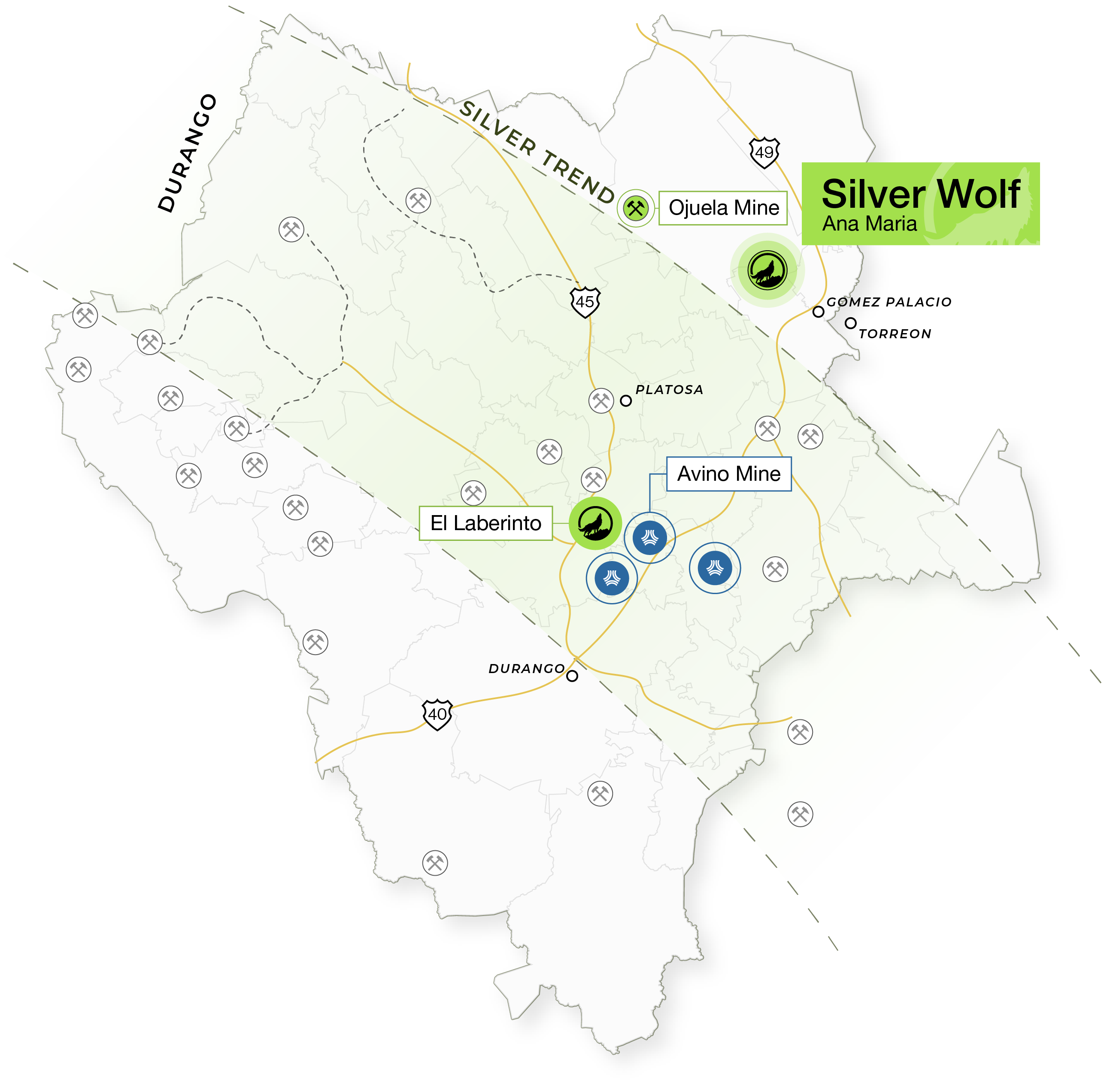
EL LABERINTO
El Laberinto is situated within the Tepehuano terrane, as are Ana Maria, La Recompensa, and the El Soldado projects, but in close proximity to the contact with the Tahue terrane, W of the Sierra Madre Oriental.
Carbonate rocks that characterize the CRD deposits of Ana Maria are absent at El Laberinto. Instead of the thrust belts of the Sierra Madre Oriental, the region is controlled by a series of North West-South East (NW-SE) to North North West-South South East (NNW-SSE) striking faults that create a horst-and-graben topography.
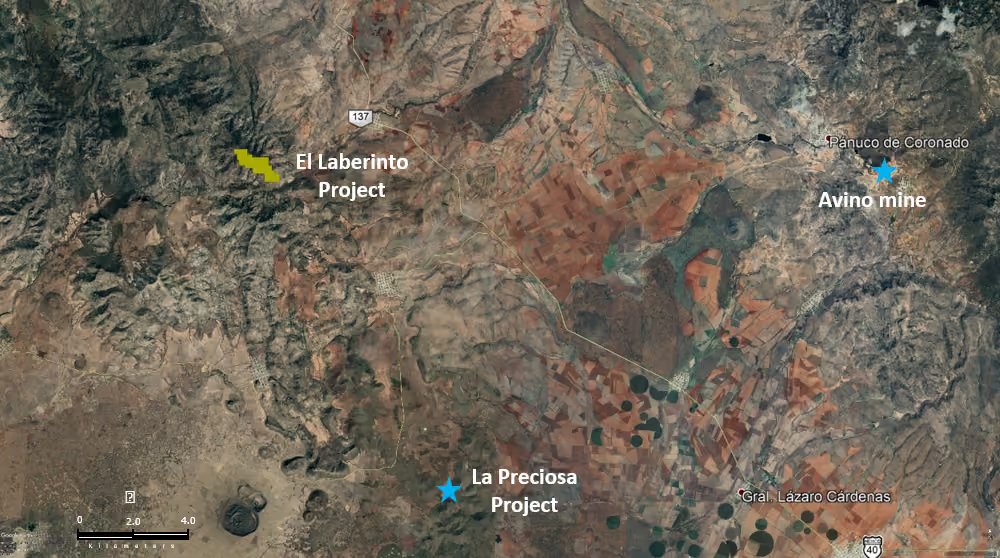
Mineralization
The main mineralized material at El Laberinto is comprised of iron, lead and zinc sulphides with minor silver sulphosalts. Gold and silver are present, along with minor lead and copper and, to a lesser extent, zinc. Gold and silver values are localized in the oxidized portions of the system, suggesting that supergene enrichment may be an important component of the deposit. Mineralization is hosted in quartz veins and veinlet zones, and to a lesser degree in disseminations around those veins and veinlets.
Mid-1990s exploration
In the mid-1990s, historical exploration at El Laberinto was carried out by Compañía Minera Mexicana de Avino S.A. de C.V., with the objective of evaluating the potential of the main vein. This work consisted of geological mapping and surface sampling, diamond drilling (3 holes totaling 753.73 metres), and mine development of the Jabalí Tunnel — a 300-metre strike length along the main structure, plus 80 metres in a cross-cut.
2012-2013 exploration
The program paired geological mapping with a systematic surface sampling campaign. A total of 208 surface samples were collected, returning values of up to 8 g/t gold and 421 g/t silver — with the most anomalous results concentrated along the Laberinto Structure.
Drilling focused on the southern portion of the Laberinto Structure, interpreted at the time to hold the best potential for large-volume, lower-grade mineralization. Five holes were completed for a total of 1,367 metres, and 2,800 samples were collected across both the alteration zones and structures, with particular emphasis on the host rock.
The historical exploration work described above is provided for reference only. It was performed by previous operators, and the Qualified Person (QP) has not validated or verified the information or any underlying data, as it is not currently available; however, the information is considered reasonable and reliable. The source is an internal report from the previous operator, Endeavour Silver Corp.